
Turning Milk to Cheese at Tonjes Farm
By Victoria Spencer - Photography by Amber Clark
Behind the big red cow barn at Tonjes Farm in Callicoon, western Sullivan County, is what looks like a door into the hillside. That door leads into Tim Tonjes’s cheese cave where he makes soft and aged cheeses, yogurts, buttermilk and kefir using the whole milk from his Holstein-Friesian cows. The steel-reinforced concrete structure is 15 feet underground with five feet of soil on the roof. It’s about 2,000 square feet in size and consists of a main cheesemaking room where Tonjes makes cheese, a cold-storage room and, at the back, an aging room. Justifying the choice to bring his cheesemaking operation to a subterranean level, Tonjes explains, “The idea was to make it ground temperature, 51 degrees Fahrenheit, and save on energy costs.” Additionally, by locating his cheese cave underground, Tonjes echoes the centuries-old tradition of aging cheese in cool, moist caves where temperature and humidity are relatively constant, the perfect conditions for ripening cheese and bringing it to its elemental peak.
Seven years ago, Tonjes, a 40-something second generation dairy farmer, found himself in the same position as many other dairy farmers, with wholesale milk prices fluctuating, usually downward, while operating costs only seemed to go up. He knew he didn’t want to increase the size of his herd and the scale of his farming. “I was looking for a different way of making a living,” he explains. “You might say it was a midlife crisis,” he jokes. His local cooperative extension had some programs for farmers looking into added value for their dairy production, and Tonjes was taken with the idea of making cheese. “It wasn’t easy at the start, it isn’t easy now,” he says. He started by studying up on the cheesemaking process; then the county’s Cheese Mobile was brought to the Tonjes farm. The cheese mobile is a New York State–approved cheesemaking plant in a trailer and is the brainchild of Rick Bishop, local farmer and the agricultural economic developer with the Sullivan County Division of Planning. The 12-foot-by-36-foot mobile cheese making facility enabled Tonjes to learn the craft within steps of his front door (Tonjes was the CheeseMobile’s first student). His training consisted of two one-day classes in the trailer with renowned cheesemakers, Peter Dixon from Vermont and Kathy Biss from the UK. He began his business by making the basics: mozzarella and yogurt and, after about four months, aged cheese. The CheeseMobile stayed on his farm for two years. It gave Tonjes the opportunity to try making cheese without having to immediately invest in his own facility until he knew for sure he wanted to be a cheesemaker. His initial interest in making cheese grew as he worked with the curd and created his own distinct products. “It came natural to me,” he says.
Despite his love of cheesemaking, Tonjes describes himself as “farmer, dairyman and cheesemaker,” and that is the progression of ranking in his mind. I need “hay to feed the cows and need cows to make the milk for the cheese.” As if these three roles aren’t enough, Tonjes also packages, distributes and markets his products. “I could have hired a cheesemaker,” he says, “or a distributor, or could get someone to market it but…” he trails off. That he does all the work, with his wife Mary and other family members, reflects his hands-on nature and is made apparent in his honest grass-fed farmstead cheeses.
All Tonjes dairy products start with the full-cream milk from his herd. His cows are born and raised on his farm, and he has about 50 milking at any given time. After milking, the milk is piped from the milking barn to the cheesemaking room. There the milk is either pasteurized, if he’s going to make fresh products—yogurts, buttermilk, kefir, fromage blanc, mozzarella and ricotta—or if he is going to make his aged cheeses, the raw milk is piped into a shiny stainless steel cheese vat. Tonjes usually works in his cheese plant 3–5 days a week. The amount of time he devotes to cheesemaking varies with the season and whether he has to make hay, put in crops or has cows in labor. In typical artisan fashion he says, “I make what I want to make when I want to make it.” And he makes it working alone unless he is making mozzarella, which is an all-day affair when Mary helps him stretch the curd. Sometimes his sons will also help with the laborious process of stretching and rolling balls of mozzarella.
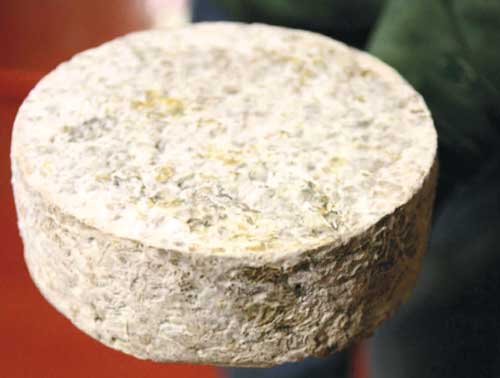
When he started making aged cheese, Tonjes made a French tomme–style cheese he named Cow Hill. It’s lightly pressed and hand-salted, with a taste that’s creamy, earthy and a little nutty. He modestly describes it as “a pretty simple cheese.” His Rambler is an English-style cheese with a similar color and rind to Cow Hill but a decidedly different taste and texture. It’s pressed to extract more whey and create a drier, smoother texture with a more definite bite. Tonjes describes it as “sort of Cheddar like,” as it also could be likened to a Gloucester variety. Caerphilly is his version of a Welsh cheese, traditionally made and consumed young. Like all of Tonjes raw-milk cheeses, the Caerphilly must by law be aged at least 60 days, and he has been aging it for around 90 days, which he finds enhances its crumbly texture and sharp tang. His blue cheese develops its exterior natural rind as it ages in the cave, while it’s interior develops the blue mold, a smooth, creamy texture and intense, rich flavor. It’s named Beechwood Blue after the area of Sullivan County where the Tonjes farm is located.
He notes that the color of the cheeses changes with the seasons. The cheeses he’s packaging to sell in early December were made in September. The cheese depends on what the cows were eating and on the quality of the forage crops Tonjes grows. His cows are grass-fed but “for me, it’s winter here most of the time,” he adds with a bit of laughter. The cows are out in the pasture from May through October. The rest of the year he needs forage crops to feed them and grows a mixture of grasses to make hay for forage. “And this year,” he says, “the forage is really nice.”
In addition to his aged cheese, Tonjes has received attention for his fromage blanc, a French soft cheese that’s similar to a cross between cream cheese and Greek yogurt and isn’t often found in the U.S. He began making it recently and finds French people come to his stall at the Callicoon or Liberty farmers’ markets and the Union Square Greenmarket on Saturdays, telling him the fromage blanc is just like they have in France. Non-French customers are also enjoying it, buying it again and again—once they get tips on how to use it, as a cheese spread with herbs, as a dessert topped with fruit and sprinkled with sugar, or in place of cream cheese or ricotta in cooking. His cultured buttermilk is also acclaimed. It’s thick and rich and very different to the supermarket always-reduced-fat version, perfect for baking or drinking.
Meanwhile Tonjes is back in his cheese cave experimenting. His small-scale production allows him to work at his own pace and to indulge his creativity. “When I’m making one cheese, I will pull some off and do a little experiment,” he says. He’s been looking into making an Asiago-like cheese. It would be his first reduced-fat cheese. If he does expand into making cheese like the Asiago, he’ll use the fat removed in cheesemaking to make small amounts of butter. He’s also, sort of, returned to his roots; he now sells his pasteurized, nonhomogenized milk (which has a varying fat content) along with his cheeses because “people kept asking for it.” And maybe because this cheesemaker is still a dairyman at heart.